11.03.2026
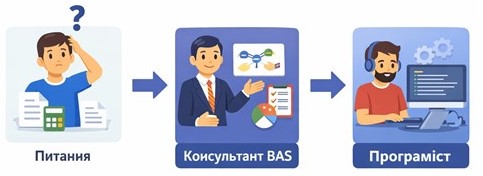
Why do you need to interact with a consultant before contacting a programmer when working at "BAS Integrated Enterprise Management"?
Imagine a typical situation: an accountant, a financier, or a sales manager realizes that the system is missing a specific report, button, or document. The first thought most users have is: "I need to write to the programmer and have them develop it."
It seems like the fastest way to solve the problem. However, when dealing with a complex system like BAS KUP (Comprehensive Enterprise Management), reaching out directly to a developer often leads to unnecessary costs, wasted time, and future update issues.
Why should the first step be a call or a ticket specifically to a consultant (analyst)? Let's break down the main reasons.
80% of "new" functions already exist in the standard functionality
BAS KUP is a powerful ERP system that incorporates hundreds of the world's best business practices. What seems like a unique need to a user has often already been implemented in the system; it might simply be disabled in the settings or located in a different section.
- What the programmer does: Receives the task "create a report" and writes code for a new report. They are not required to know all the nuances of accounting methodology.
- What the consultant does: Analyzes your need and, most likely, within 10 minutes shows you how to get the required data using standard universal reports or by changing user settings.
The Result: You save money on development and avoid "cluttering" the system with unnecessary code.
The problem of translating from "Business" to "IT"
Users think in categories of their processes: "I need it so that when I post this invoice, the number goes here, and this part turns red."
Programmers think in categories of database architecture: registers, catalogs, documents, and queries. When these two people speak directly, a "broken telephone" effect occurs. The programmer does exactly what they were told, but as a result, it doesn't solve the business task or it breaks adjacent processes.
The consultant acts as a translator. They deeply understand both the enterprise's business processes and the BAS KUP architecture. They transform a user's emotional request into a clear, technically sound Technical Specification (TS) for the programmer.
Protecting the system from "crutches" and update issues
Every new line of non-standard code in BAS KUP is your technical debt. The more the system is taken off standard support (i.e., customized), the harder, longer, and more expensive it will be to install official updates (which are critical for regulated accounting).
The consultant stands guard over your database architecture:
- They evaluate whether the customization is truly worth complicating future updates.
- If customization is inevitable, they design it to be implemented through safe mechanisms (extensions, additional attributes, external reports) without touching the system's "core."
Seeing the whole picture
An enterprise is a single organism. If a procurement manager asks to change the posting logic for a "Goods Receipt" document, they may not realize that this will critically affect the cost calculation performed by the finance department at the end of the month.
A programmer, receiving a specific task, will execute it locally. A consultant, however, sees the entire architecture and will immediately warn: "We cannot change this register because it will break the month-end closing. Let's solve your task another way".
The correct algorithm for working with customizations in BAS KUP
To ensure your system works stably and brings benefits rather than headaches, the interaction process should look like this:
- Need arises: The user realizes something is missing.
- Consultant audit: The consultant analyzes the request. If it can be solved with standard functionality—they configure it and train the user.
- Creation of Technical Specification (if no standard solution exists): The consultant designs the customization architecture and writes the TS.
- Development: The programmer writes the code quickly and without errors based on the clear TS.
- Testing: The consultant tests the development to ensure it solves the business task and doesn't break other processes.
- Handover to the user.
Conclusion
A programmer in the world of BAS KUP is like a surgeon whose time and skills are expensive, and whose intervention must be justified. A consultant is a therapist and diagnostician who can often solve the problem with the right prescription without surgical intervention.
By involving a consultant at the first stage, you preserve the system's flexibility, save the company's budget, and are guaranteed to receive a tool that works for your business.